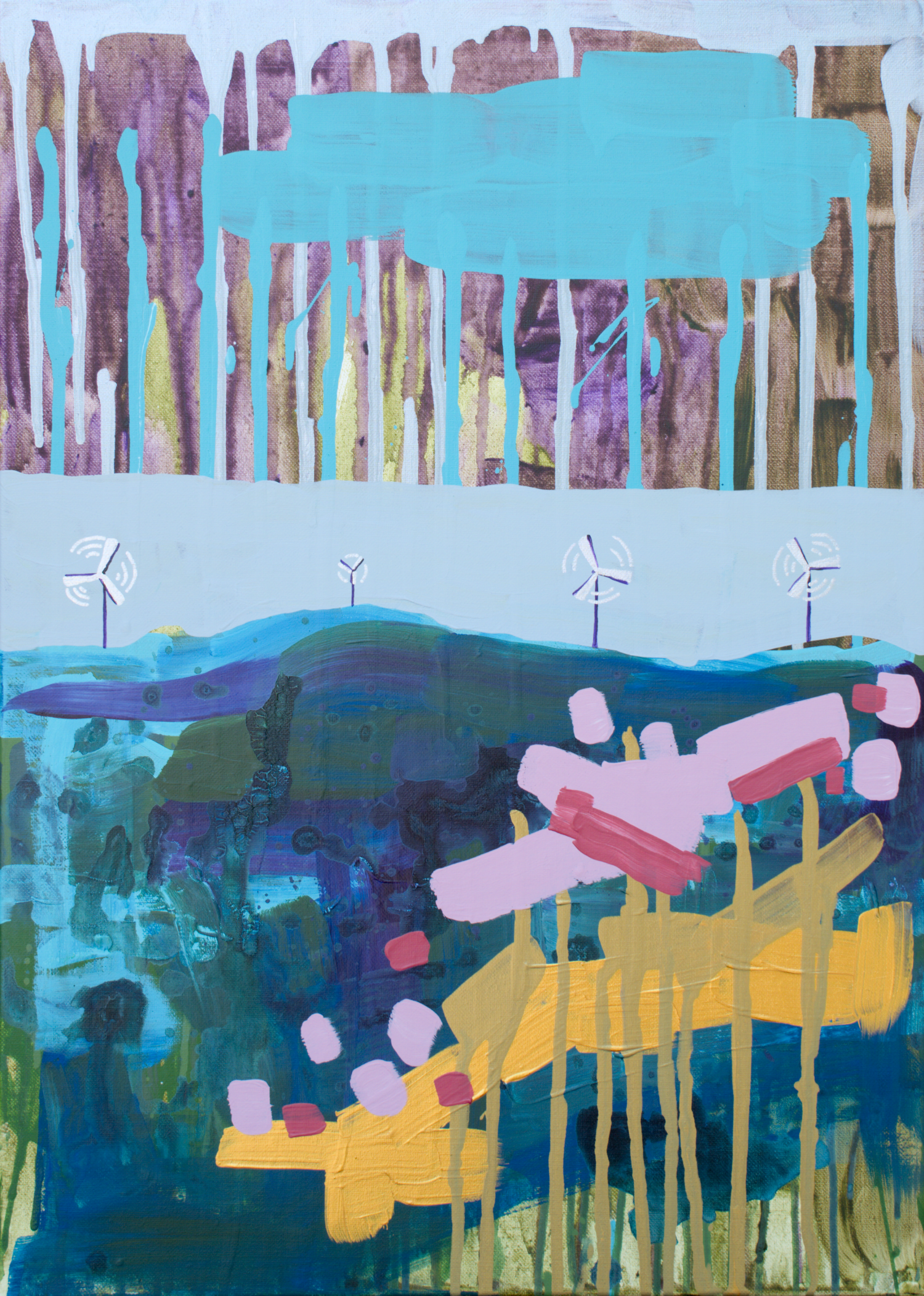
Valley of the eternal wind
Acrylic paint and markers on canvas, 50 × 70 cm.
Audio companion
Visual description
Narrative description
Read audio transcripts
Visual description
Alt text: Abstract blue and turquoise landscape featuring four thin wind turbines on a light horizon line
Detailed description:
Leidari Dey
Valley of the Eternal Wind.
Acrylic on canvas (stretched on stretcher bars, unframed).
50×70 cm, vertical.
Style: Abstract with landscape elements.
The painting is built on a combination of light blue, deep blue, turquoise, pink, and golden tones.
The upper part of the canvas is filled with vertical drips and bands of purple, brownish-gold, and gray-beige. Over them lies a wide horizontal layer of light turquoise paint with drips running downward.
Below this runs a light-blue horizontal band that forms the horizon line. On it are four wind turbines. They are shown as thin vertical poles with three-bladed rotors. Around the blades, semicircular lines indicate rotation.
The lower half of the painting is filled with layers of dark blue, turquoise, and green applied in wide semi-transparent strokes.
In the lower-right area, there are large light-pink brushstrokes with a darker pink stripe laid across them. Nearby, a wide diagonal band of golden-yellow paint runs across the surface, with vertical drips flowing downward.
Small pink and pale pink patches of irregular shape are also visible in the lower part of the painting.
Narrative description
He loved wearing white shirts because they reminded him of the times when he was needed. Or was that just an illusion? Be that as it may, he felt like one of those people who are busy with something real—not just loitering in the streets, but working for the collective.
Years passed, life changed, and with those changes came old age. Messy and tiring, yet on the whole, not as terrible as the elders used to say when he was young. It was a bit lonely, but only as he fell asleep, so before bed, he would prepare another white shirt—iron it, starch it, hang it ready on the back of the wardrobe. He’d sigh with satisfaction and tell himself: "They are waiting for me tomorrow."
And in the morning, he put on the shirt because he couldn't leave the person he had been the night before all alone. Doing it up, button by button, he’d say: "Thank you, my dear, what a fine man you are, how well you've supported the collective in my person." He’d look in the mirror and repeat: "Look at that, just lovely."
"And now, shall we take a stroll to the sea, my dear? There are crayfish and white at the beach cafe today. It’s high time to live well."